
Blog
What Is Cellulose Cooler Mesh? Complete Guide to Selection, Benefits, and Installation

What Is Cellulose Cooler Mesh? Complete Guide to Selection, Benefits, and Installation

Evaporative coolers with cellulose pads have become increasingly popular in residential, commercial, and some industrial buildings. Their higher efficiency, more uniform cooling performance, and improved airflow distribution make them an effective alternative to traditional straw-pad coolers.
However, like any ventilation system, the performance of a cellulose evaporative cooler largely depends on the quality of the incoming air.
Outdoor air is not always clean. Dust, airborne particles, dry leaves, lint, insects, and other environmental contaminants can enter the cooler along with the airflow. If these particles reach the cellulose cooling pads directly, they can gradually accumulate on the pad surface, reducing cooling efficiency, increasing maintenance requirements, and potentially shortening the service life of the pads.
In this situation, cellulose cooler mesh can be used as a protective layer at the air intake to help reduce the entry of larger contaminants into the unit. However, selecting the right mesh is important. If the mesh is too dense, it may restrict airflow and negatively affect cooler performance.
Therefore, the ideal cellulose cooler mesh should provide a balance between maintaining sufficient airflow and reducing the entry of unwanted particles.
In this article, we explain how cellulose evaporative coolers work, what cellulose cooler mesh is used for, where it should be installed, which features are important, and how it can help protect cellulose cooling pads and maintain system performance. We will also examine polyester mesh used in ventilation systems and the key factors to consider when selecting it.
Note: In this article, cellulose cooler mesh refers to the protective mesh installed at the cooler’s air intake, before the cellulose cooling pads, to reduce the entry of larger particles and environmental contaminants.
How Does a Cellulose Evaporative Cooler Work?

To understand the importance of cellulose cooler mesh, it is first necessary to understand how this type of cooler operates.
Cellulose evaporative coolers use an evaporative cooling process. Water continuously flows over the cellulose cooling pads and keeps them wet. At the same time, the cooler fan draws outdoor air into the unit and passes it through the wet pads.
As the air moves through the pads, part of the water evaporates and absorbs heat from the air. The resulting cooler air is then directed through the duct system into the building.
What distinguishes cellulose cooling pads from traditional straw pads is their structured honeycomb design. This structure allows water to distribute more evenly across the pad while creating a larger contact area between water and air. The result is improved cooling efficiency and, in many applications, lower water consumption compared with traditional coolers.
Despite these advantages, cellulose pads are sensitive to environmental contamination. When dust and larger particles accumulate on the pad surface, the air passages can gradually become blocked, reducing cooler efficiency.
For this reason, protecting the incoming airflow from larger contaminants can be beneficial. Installing suitable cellulose cooler mesh at the air intake is one practical approach, provided that the mesh does not significantly restrict airflow.
Main Components of a Cellulose Evaporative Cooler
A cellulose evaporative cooler depends on the coordinated operation of several main components:
- Cellulose cooling pads: Responsible for the evaporative cooling process.
- Fan or blower: Creates airflow and delivers cooled air into the building.
- Water pump: Supplies and circulates water over the cooling pads.
- Water distribution system: Keeps the cellulose pads uniformly wet.
- Air intake: The section through which outdoor air enters the unit and an appropriate location for installing cellulose cooler mesh.
Where Is the Air Intake of a Cellulose Cooler and Why Is It Important?

Most users focus on the motor, water pump, or cellulose pads during cooler maintenance. However, the air intake is another important part of the system.
The air intake is the first point of contact between the cooler and the outdoor environment. Anything carried by the incoming air passes through this area before reaching the cooling pads.
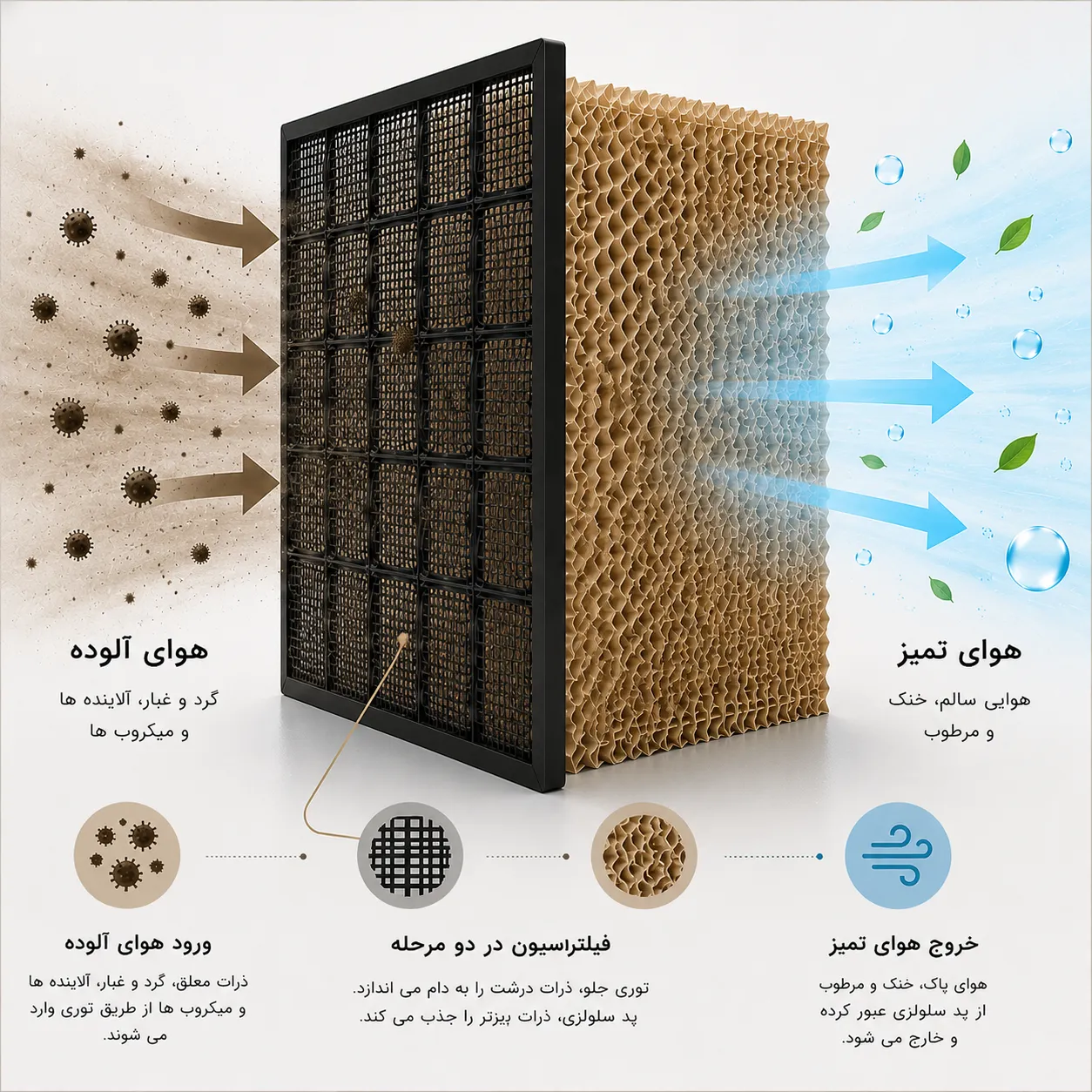
In most cellulose evaporative coolers, air enters through panels positioned around the unit where the cooling pads are installed. When the fan operates, outdoor air passes through these panels and the wet pads before moving toward the blower and outlet duct.
Because cellulose coolers are often installed on rooftops, terraces, or other outdoor areas, the incoming air may contain:
- Wind-blown dust
- Sand and fine soil particles
- Dry leaves and plant debris
- Small insects
- Lint, fibers, and airborne fluff
- Soot and traffic-related pollutants in urban environments
If these contaminants enter the unit without protection, some may remain on the cellulose pads while others can move into internal components. Gradual accumulation can reduce airflow quality, increase maintenance frequency, and affect cooling efficiency.
Installing suitable cellulose cooler mesh at the air intake can therefore act as a first protective layer against larger particles.
What Is Cellulose Cooler Mesh and What Does It Do?

Cellulose cooler mesh, sometimes referred to as evaporative cooler filter mesh or split AC mesh depending on the application, is a protective mesh installed in the incoming airflow path before air reaches the cellulose cooling pads.
Its primary purpose is to reduce the entry of external contaminants such as dust, small leaves, insects, and other airborne particles.
A cellulose evaporative cooler requires a specific volume of air to achieve effective cooling. Therefore, the mesh should provide particle control without creating excessive resistance to airflow.
In simple terms, suitable cellulose cooler mesh should balance two important functions:
- Reducing the entry of contaminants
- Maintaining sufficient airflow
If the mesh is excessively dense, it may act as an airflow barrier and reduce cooler efficiency. If the openings are too large, however, its ability to control particles will be reduced.
The correct choice should therefore consider the cooler’s airflow capacity, installation environment, dust levels, and intended application.
Why Is Cellulose Cooler Mesh Important?
Cellulose cooling pads are the core component of an evaporative cooling system. Their honeycomb structure creates a large contact area between water and air, which supports efficient cooling.
However, the same porous structure can be sensitive to contamination. When dust and airborne particles enter the pads directly, they may gradually accumulate inside the passages.
Using cellulose cooler mesh as an initial protective layer can help reduce this contamination.
1. Reducing Dust Entry into Cellulose Cooling Pads
Dust accumulation on the cooling pads is one factor that can affect cooler performance.
Dust can contribute to:
- Reduced water-air contact
- Reduced water absorption by the pad
- Lower airflow through the pad
- Increased cleaning and maintenance requirements
Installing cellulose cooler mesh at the air intake can help capture some larger particles before they reach the pads.
2. Supporting Longer Pad Service Life
Cellulose cooling pads require periodic inspection, maintenance, and eventual replacement. Reducing the amount of contamination reaching the pads can help slow the buildup of debris within their passages.
A protective mesh can help:
- Keep the pad surface cleaner for longer
- Maintain more consistent water absorption
- Support stable cooling performance over time
However, mesh is not a replacement for regular cooler maintenance. It should be considered an additional protective layer.
3. Helping Maintain Cooler Efficiency
One of the advantages of cellulose evaporative coolers is their ability to provide cooling with relatively efficient energy use. Anything that restricts airflow or interferes with pad performance can affect the overall system.
A properly selected cellulose cooler mesh should:
- Create limited resistance to airflow
- Provide sufficient open area
- Protect the system without disrupting normal cooler operation
For this reason, both mesh material and mesh density are important.
Important Features of Suitable Cellulose Cooler Mesh
Not every mesh is suitable for ventilation applications. Mesh installed at the air intake of a cellulose cooler should meet several functional requirements.
1. Good Air Permeability
The first and most important feature of cellulose cooler mesh is maintaining adequate airflow.
The cooler fan must be able to draw the required volume of outdoor air. If the mesh is too dense, airflow resistance may increase and the cooling capacity may be affected.
For this reason, ventilation meshes are commonly produced with different opening sizes and densities.
2. Ability to Control Airborne Particles
The mesh structure should be capable of blocking at least some of the particles carried by the incoming air.
Filtration performance depends on factors such as:
- Mesh opening size
- Thread diameter
- Mesh material
- Air velocity
For cellulose coolers, the objective is generally to reduce larger particles and contaminants rather than create a completely closed filter that restricts airflow.
3. Moisture Resistance
Because cellulose evaporative coolers operate in a humid environment, the mesh material is important.
The selected mesh should have suitable resistance to:
- Continuous moisture exposure
- Water vapor
- Outdoor environmental conditions
Polymeric materials such as polyester, polypropylene, and polyethylene are used in various air filtration and ventilation applications.
4. Easy Cleaning and Maintenance
Another useful characteristic is easy cleaning.
During routine cooler maintenance, the air-intake mesh can be inspected and cleaned when necessary. This helps remove accumulated contaminants before they reach the cellulose pads.
How Does Mesh Material Affect Cellulose Cooler Performance?

The mesh material directly affects durability, airflow characteristics, and overall performance.
For ventilation equipment, material selection is important because the mesh needs to remain lightweight while providing stable performance under different environmental conditions.
One option worth considering is split polyester mesh.
Polyester mesh offers characteristics such as:
- Suitable weight
- Uniform structure
- Availability in different densities
- Suitable resistance to environmental conditions
These characteristics make polyester mesh useful in various ventilation and air-filtration applications and make it an option worth evaluating for cellulose cooler mesh applications.
Why Can Polyester Split AC Mesh Be Suitable for Cellulose Coolers?
When selecting cellulose cooler mesh, the mesh material is one of the factors that can affect durability, airflow, and overall performance.
Ventilation systems commonly use both metal and polymeric meshes. While metal mesh can be effective in certain applications, polymeric meshes may be attractive in environments with continuous moisture because of their corrosion resistance and lower weight.
Among polymeric materials, polyester is used in many ventilation applications because of its stable structure, availability in different densities, and suitable airflow characteristics.
However, final selection should be based on the installation environment, contamination level, required airflow capacity, and technical specifications of the cooler.
Technical Specifications of Polyester Split AC Mesh
Polyester mesh used in ventilation applications can be manufactured in different dimensions and specifications depending on the intended use.
| Specification | Value |
|---|---|
| Mesh openings per centimeter | 8–18 |
| Mesh openings per inch | 25–46 |
| Thread diameter | 0.20 mm |
| Available colors | White, clear, black |
| Production width | 100 and 200 cm; custom sizes available |
| Materials | Polyester, polypropylene, polyethylene |
| Airflow capacity | Approximately 5,000–9,500 CFM |

The availability of different materials, mesh openings, and dimensions makes these meshes suitable for a variety of air circulation and filtration equipment.
Polyester Mesh vs. Other Mesh Materials for Ventilation
Choosing the right mesh is not based on material alone, but understanding the differences between materials can support better decision-making.
| Feature | Polyester | Polypropylene | Polyethylene |
|---|---|---|---|
| Good airflow | ✔ | ✔ | ✔ |
| Moisture resistance | Very good | Good | Good |
| Mechanical durability | Very good | Good | Moderate |
| Available in different mesh openings | ✔ | ✔ | ✔ |
| Suitable for ventilation applications | ✔ | ✔ | ✔ |
All three materials can be used in ventilation applications, and the final selection should be based on the requirements of each project.
How to Choose the Right Mesh Opening Size?
A common mistake is choosing mesh based only on whether the openings are fine or coarse. The correct selection should instead be based on the desired performance.
In environments with high dust levels, finer mesh openings may be considered to control more particles. If maximizing airflow is the primary objective, a more open mesh may be preferable.
When selecting cellulose cooler mesh, consider:
- Cooler airflow capacity
- Local climate conditions
- Environmental dust levels
- Air intake dimensions
- Cleaning and maintenance requirements
Correct selection helps protect the cooler without unnecessarily restricting airflow.
Introducing Beltash Polyester Split AC Mesh

Beltash manufactures industrial meshes and air-filtration products designed for different applications, with customization options based on project requirements.
Beltash split AC mesh is designed for ventilation applications and offers features such as:
- Uniform and high-quality structure
- Availability in different mesh openings
- Various production widths
- Different colors and materials
- Customization according to customer requirements
These features allow Beltash meshes to be used in different ventilation equipment, including air conditioners, fan-coil units, industrial hoods, and other air circulation systems.
When using this type of mesh at the air intake of cellulose evaporative coolers, selecting the appropriate technical specifications and evaluating the actual operating conditions are essential.
How to Install Cellulose Cooler Mesh

One of the advantages of cellulose cooler mesh is its relatively simple installation at the air intake.
The mesh is generally installed over the air-intake panels and before the cellulose pads so that larger airborne particles can be captured before reaching the pads.
Because cooler designs differ between manufacturers, the exact installation method may vary. However, the general process is:
- Turn off the cooler and disconnect the power.
- Remove the side or intake panel.
- Measure the air-intake area.
- Cut the mesh to the required dimensions.
- Position the mesh over the air intake and secure it with suitable fasteners or holders.
- Make sure the mesh does not block the airflow path.
- Reinstall the panel.
Important: The mesh should be installed securely while remaining accessible for periodic cleaning and maintenance.
Does Cellulose Cooler Mesh Reduce Airflow?
One of the most common questions about cellulose cooler mesh is whether installing it reduces the cooler’s airflow or cooling performance.
The answer depends on the mesh type and how it is selected.
If the mesh openings are extremely fine or a large portion of the air intake is blocked, airflow resistance may increase and the cooler’s airflow capacity may decrease.
On the other hand, if a mesh with suitable specifications and sufficient open area is selected and properly installed, its impact on airflow can be minimized while still helping reduce the entry of environmental contaminants.
Therefore, the most important factor is choosing mesh specifications that match the cooler’s operating conditions.
Maintenance Tips for Cellulose Cooler Mesh
Like other ventilation components, the mesh requires periodic inspection and cleaning to maintain its performance.
The following practices can help:
- Inspect the mesh during regular cooler maintenance.
- Clean accumulated dust according to the mesh material.
- Avoid excessive stretching or mechanical pressure.
- Replace the mesh if it becomes damaged or torn.
- Avoid corrosive cleaning agents.
Proper maintenance can extend mesh service life while helping maintain suitable airflow.
Common Mistakes When Choosing Cellulose Cooler Mesh
Incorrect mesh selection can reduce system efficiency. Understanding common mistakes can help you choose more effectively.
Choosing Extremely Fine Mesh
Excessively dense mesh may restrict airflow and negatively affect cooler performance.
Using Mesh Unsuitable for Humid Environments
The selected mesh should be compatible with the cooler’s operating conditions and provide suitable moisture resistance.
Ignoring Periodic Maintenance
Even high-quality mesh can accumulate dust and contaminants if it is not cleaned regularly.
Choosing Incorrect Dimensions
The mesh should match the dimensions of the cooler air intake so that the required area is fully covered and the mesh remains securely installed.
Frequently Asked Questions About Cellulose Cooler Mesh
What is cellulose cooler mesh?
Cellulose cooler mesh is a protective mesh installed at the air intake of a cellulose evaporative cooler. Its main purpose is to reduce the entry of dust, airborne particles, insects, and environmental contaminants while helping protect the cellulose cooling pads.
The mesh should provide particle control while maintaining adequate airflow.
Where is cellulose cooler mesh installed?
Cellulose cooler mesh is generally installed at the air intake, before the incoming air reaches the cellulose cooling pads.
The airflow path can be summarized as:
Outdoor air → Protective mesh → Cellulose pad → Internal cooler → Cooled air
Installing the mesh in this position allows some contaminants to be controlled before reaching the cooling pads.
Does mesh reduce the airflow of a cellulose cooler?
If the mesh is correctly selected, its effect on airflow can be minimized.
The opening size, mesh material, and open-air area are important factors. Extremely dense or unsuitable mesh may increase airflow resistance.
What is the best material for cellulose cooler mesh?
The best material depends on the environmental conditions and intended application. Polymeric meshes such as polyester, polypropylene, and polyethylene are used in ventilation applications.
Polyester can be considered because of its uniform structure, availability in different densities, suitable environmental resistance, and customization options.
How often should cellulose cooler mesh be cleaned?
Cleaning frequency depends on the environment. In areas with high dust levels, the mesh should be inspected more frequently.
During routine cooler maintenance:
- Inspect the mesh condition.
- Remove accumulated dust.
- Replace the mesh if damaged.
Is one mesh suitable for all cellulose evaporative coolers?
No. Mesh selection should consider:
- Cooler airflow capacity
- Air-intake dimensions
- Local climate
- Environmental contamination
- Required level of particle control
The availability of different mesh specifications is therefore useful for ventilation and industrial applications.
What is the difference between ordinary mesh and polyester ventilation mesh?
Ventilation mesh must control airborne particles while maintaining adequate airflow.
Polyester mesh, with its controlled structure and availability in different opening sizes, can be considered for applications requiring a balance between airflow and contamination control.
Final Conclusion
Cellulose evaporative coolers are widely used because of their effective evaporative cooling performance. However, direct entry of dust and airborne particles can gradually affect cellulose pad performance and increase maintenance requirements.
Using cellulose cooler mesh at the air intake can act as a protective layer, helping reduce the entry of contaminants and support more stable system performance.
When choosing the mesh, factors such as material, density, opening size, airflow capacity, and environmental conditions should be considered. Polyester meshes designed for ventilation applications can be an option worth evaluating because they are available in different specifications and can be customized for different applications.
Summary
Dust, airborne particles, and environmental contaminants entering a cellulose evaporative cooler can gradually affect cooling pads and overall system efficiency. Properly selected and installed cellulose cooler mesh can help reduce the entry of larger particles and provide additional protection for internal components.
When selecting mesh, pay attention to the material, opening size, airflow capacity, and resistance to environmental conditions. Polyester split AC mesh designed for ventilation applications can be considered when different dimensions and mesh densities are required.
If you need to select suitable mesh for a cellulose evaporative cooler or another ventilation system, compare the product specifications with your project requirements and consult the manufacturer when necessary.
Need Help Choosing the Right Mesh?
If you need technical guidance for selecting cellulose cooler mesh for ventilation systems or cellulose evaporative cooler air intakes, Beltash specialists can evaluate your application requirements and help identify a suitable option.