
Blog
Silk Screen Mesh Selection Guide; How to Choose the Right Mesh and Color?

Silk Screen Mesh Selection Guide; How to Choose the Right Mesh and Color?
Choosing the right mesh is one of the most important stages in the screen printing process and can directly affect print quality, ink transfer volume, detail clarity, color coverage, and the final accuracy of the design. Therefore, having a silk screen mesh selection guide helps you avoid focusing on only one number or specification when purchasing and selecting a mesh, and instead consider all relevant factors together.
One of the most important points in silk screen mesh selection is understanding the difference between the mesh code and mesh count. These two specifications are not the same and should not be used interchangeably.
For example, T48-70W silk screen mesh code has a mesh count of 122. Therefore, when selecting a mesh, you should not assume that the number included in the code represents the actual Mesh Count. The code is an identifier or product specification, while the mesh count indicates the density of the mesh threads. For this reason, when selecting a mesh, you should always check the actual Mesh Count in the product’s technical specifications.
In this article, by examining different mesh counts, mesh color, ink type, design detail level, and other technical specifications, we provide a practical silk screen mesh selection guide to help you choose a more suitable mesh for each project.
What Is Silk Screen Mesh?
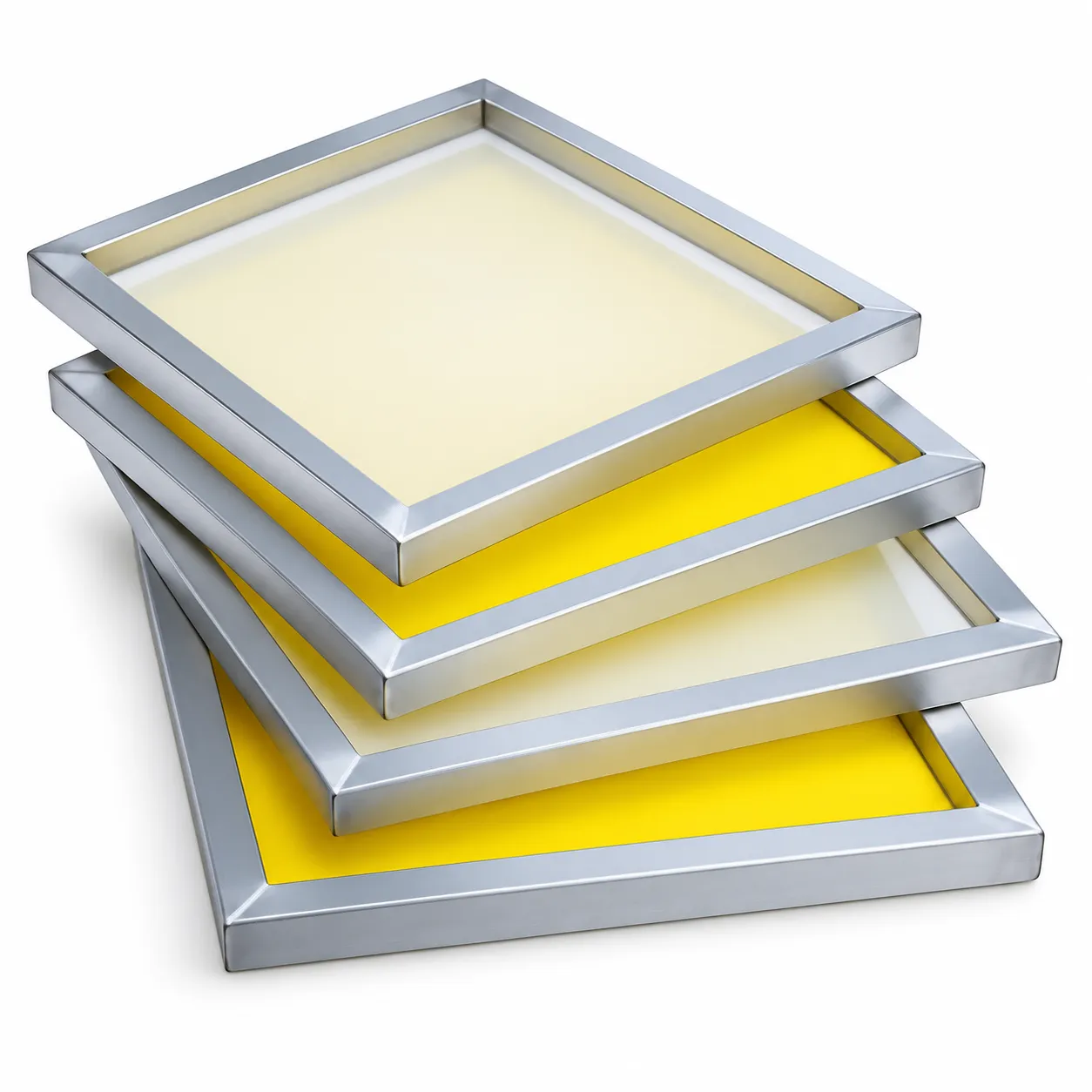
Silk screen mesh is a mesh surface stretched over a printing frame, on which the printing stencil is created. Although natural silk was historically used to manufacture this type of mesh, polyester mesh is now widely used because of its strength, dimensional stability, and suitable performance.
In the screen printing process, the open areas of the stencil allow ink to pass through, while the blocked areas prevent ink from passing. Therefore, the mesh structure plays an important role in the amount of ink transferred and its ability to reproduce details.
For selecting the right silk screen mesh, the following factors should be considered:
- Mesh Count
- Thread diameter
- Opening size
- Percentage of open area
- Mesh color
- Mesh tension
- Ink type
- Design detail level
- Required coverage
What Is Mesh Count and Why Is It Important?

One of the most important mesh specifications is Mesh Count.
Mesh Count refers to the number of mesh threads per inch. The higher the mesh count, the greater the number of threads per inch and the smaller the mesh openings. Mesh refers to the number of mesh threads per unit of length and, in the common system, is measured as the number of threads per inch.
In general, as Mesh Count increases, the mesh becomes more densely woven and its openings become smaller.
Simply stated:
Lower mesh → larger openings → more ink transfer
Higher mesh → smaller openings → less ink transfer and greater control over details
However, this is a general rule. For accurate mesh selection, specifications such as thread diameter and percentage of open area should also be evaluated.
Difference Between Mesh Code and Mesh Count
If we were to summarize the most important point in this silk screen mesh selection guide in one sentence, it would be:
Mesh code is not the same as Mesh Count.
The mesh code is used to identify a specific product or structure, while Mesh Count indicates the actual density of the mesh threads.
For example:
Mesh code: T48-70W
Mesh Count: 122
Therefore, if you need a 122 Mesh for a particular project, you should select a product whose technical specifications state that it has a Mesh Count of 122, rather than making your decision solely based on the numbers or letters contained in the product code.
This is particularly important when purchasing mesh because two meshes with different codes may have a similar Mesh Count, while meshes with the same Mesh Count may perform differently due to differences in thread diameter and weave structure.
Difference Between Mesh Count Expressed per Inch and per Centimeter
One point that may cause confusion when selecting silk screen mesh is the difference in how mesh density is expressed in different technical specifications. In different sources and markets, mesh density may be expressed as the number of threads per inch or the number of threads per centimeter.
In the common Mesh Count system, the mesh number indicates the number of mesh threads in one inch of length. For example, 110 Mesh has 110 threads per inch, while 230 Mesh has 230 threads per inch. As Mesh Count increases, the mesh openings become smaller and it generally becomes possible to transfer a thinner ink layer and reproduce finer details.
On the other hand, if mesh density is specified in threads per centimeter, it can be approximately converted to threads per inch by multiplying the value by 2.54. For example:
48 threads per centimeter × 2.54 ≈ 122 threads per inch
For this reason, you may encounter a mesh specification such as T48-70W, while its actual Mesh Count is stated as 122 Mesh. In this case, 48 should not be considered the product’s final Mesh Count; instead, the product’s technical specifications should be checked to determine the actual mesh value.
Important note: When selecting silk screen mesh, always use the Mesh Count stated in the product’s technical specifications as the reference, and do not assume that the mesh code or model name is the same as the Mesh Count.
Quick Silk Screen Mesh Selection
If we want to make an initial mesh selection without going into technical details, we can use the relationship between design type, level of detail, ink type, and ink transfer volume. In general, lower mesh counts have larger openings and transfer more ink, while higher mesh counts are more suitable for fine details and lower ink transfer.
| Application | Suggested Mesh |
|---|---|
| Glitter, Shine, and inks containing coarse particles | 40 to 86 Mesh |
| Simple designs, Bold lettering, and high coverage | 86 to 137 Mesh |
| Underbase and white printing on dark backgrounds | 110 to 156 Mesh |
| General printing and designs with medium detail | 137 to 200 Mesh |
| Fine lines and small lettering | 200 to 230 Mesh |
| Halftone, images, and high-detail work | 230 to 305 Mesh |
| Extremely fine and specialized printing | Above 305 Mesh |
Note: This table is an initial guide for silk screen mesh selection and should not be used as the only selection criterion. Ink type, viscosity, particle size, thread diameter, open area, design type, and required coverage must also be considered. Specialized sources also emphasize that mesh selection is not based solely on design detail; ink type and ink thickness are also important.
Silk Screen Mesh Selection Guide Based on Design Type

One of the primary factors in silk screen mesh selection is the level of detail in the design.
Simple and bold designs generally require a lower mesh because the primary objective is to transfer sufficient ink and achieve adequate coverage.
In contrast, designs containing fine lines, small lettering, extensive details, or Halftone generally require a higher mesh.
Therefore, before selecting the mesh, it is better to determine:
Does your design require greater coverage or greater control over detail?
The answer to this question can provide a suitable starting point for mesh selection.
40 to 86 Mesh; Suitable for Inks Containing Coarse Particles
Meshes in the 40 to 86 range have relatively large openings and can be suitable for thick inks or inks containing larger particles.
This range can be used for:
- Glitter
- Some specialty-effect inks
- Inks containing particles
- Thick printing
- Simple designs requiring high coverage
If the ink contains relatively large particles, using a very high mesh can make ink transfer difficult.
86 to 137 Mesh; Suitable for Greater Coverage
This range is widely used for printing applications that require a larger volume of ink transfer.
Applications include:
- Bold designs
- White printing on dark garments
- Underbase
- Graphic designs with limited detail
- Relatively thick inks
In general, the greater the required coverage, the more reasonable it can be to use a lower mesh.
110 to 156 Mesh; Suitable for General Printing and Underbase
Meshes from 110 to 156 are among the commonly used ranges in screen printing and can be used for a wide variety of projects.
Applications in this range include:
- Underbase
- White printing
- Bold designs
- Designs with medium detail
- General printing
A 110 Mesh typically transfers more ink than higher mesh counts, while meshes closer to 156 provide a better balance between coverage and detail.
156 to 200 Mesh; A Balance Between Coverage and Detail
If your design has a medium level of detail while still requiring an appropriate amount of ink, the 156 to 200 Mesh range can be a suitable choice.
This range can be used for:
- Graphic designs
- Medium-sized lettering
- Images with medium detail
- General printing
- Some more fluid inks
200 to 230 Mesh; For Finer Details
As mesh count increases, the mesh openings become smaller and more precise control over ink transfer is possible.
Meshes from 200 to 230 can be suitable for:
- Fine lines
- Small lettering
- Greater detail
- Precise graphic designs
- Some Halftone applications
Within this range, selecting the correct mesh color also becomes more important.
230 to 305 Mesh; Suitable for Halftone and High Detail
Meshes from 230 to 305 are used more extensively for printing applications that require greater accuracy and control.
This range can be suitable for:
- Halftone
- Extremely fine lines
- Small lettering
- Highly detailed images
- Complex designs
- Precision printing
In such applications, in addition to Mesh Count, attention should be paid to thread diameter, percentage of open area, mesh color, and exposure settings.
Mesh Counts Above 305; For More Specialized Applications
This range is used for projects requiring extremely precise control over ink and reproduction of very fine details.
Therefore, a complete silk screen mesh selection guide should also consider mesh counts above 305, particularly for applications requiring the highest level of precision.
Silk Screen Mesh Selection Guide Based on Color

Mesh color is one of the factors that should not be overlooked when purchasing and selecting screen printing mesh.
Screen printing meshes are manufactured in different colors, with the most important including:
- White
- Yellow
- Orange
The difference between these colors is not merely visual. Mesh color affects the amount of light scattering during stencil exposure and can influence the registration of edges and details.
White Mesh; Suitable for General Applications
White mesh is a common option for screen printing and is used in many general applications.
It is suitable for:
- Simple designs
- Bold designs
- General printing
- Low and medium mesh counts
- Projects with lower sensitivity to fine detail
White mesh allows light to pass through with greater scattering compared with colored mesh. Therefore, for highly detailed work, colored mesh may provide more precise results.
Yellow Mesh; Suitable for Details and Halftone
Yellow mesh is used to reduce light scattering during stencil exposure.
Reducing light scattering can allow image edges to be registered more accurately on the emulsion. This characteristic is useful in applications where fine details are important.
Yellow mesh can be a suitable choice for:
- Halftone
- Fine lines
- Small lettering
- Complex designs
- Higher mesh counts
However, the exposure time for yellow mesh is not the same as that for white mesh and should be adjusted and tested according to the emulsion type, light source, and working conditions.
Orange Mesh; For Greater Light Control in Precision Work
Orange mesh is also used to provide greater control over light scattering during exposure and can be a suitable option for projects where stencil accuracy is highly important.
This type of mesh can be used for:
- Extremely fine details
- Halftone
- Very small lettering
- Complex designs
- High-precision printing
As with yellow mesh, exposure for orange mesh should be adjusted according to the equipment and materials being used, and a single fixed exposure time cannot be applied to all conditions.
White, Yellow, or Orange Mesh; Which Should You Choose?
No single color is absolutely the best choice for every project.
If your work is simple and does not contain extremely fine details, white mesh can be completely suitable.
If the design contains more detail, small lettering, or Halftone, yellow mesh may be a more suitable choice.
For highly precise and sensitive work, orange mesh can also be an appropriate option.
Therefore, when selecting silk screen mesh, it is better to evaluate mesh color together with Mesh Count rather than considering each factor separately.
Is Mesh Count Alone Enough to Select the Right Mesh?
No.
A common mistake is to assume that two meshes with the same Mesh Count will perform exactly the same.
In practice, specifications such as thread diameter, opening size, and percentage of open area can change mesh performance.
Thread Diameter
Thread diameter affects the opening size and open area of the mesh.
Opening Size
The mesh opening determines how freely ink can pass through the mesh.
Percentage of Open Area
The percentage of open area indicates how much of the mesh surface is available for ink transfer.
Mesh Thickness
Mesh thickness can also affect the amount of ink transferred and the formation of the ink layer.
Mesh Tension
Proper and uniform tension is important for print accuracy, Registration, and consistency of the final result.
Therefore, if you are looking for professional silk screen mesh selection, it is better to review the product’s complete technical specifications and not make your decision based on Mesh Count alone.
Common Mistakes in Silk Screen Mesh Selection
Selecting mesh based on only one number or one characteristic can reduce print quality and cause problems with ink transfer. For silk screen mesh selection, it is better to consider several factors simultaneously.
1. Confusing Mesh Code with Mesh Count
One of the most common mistakes is assuming that the mesh code represents the Mesh Count. As explained earlier, these are two different concepts. For example, mesh code T48-70W has a Mesh Count of 122; therefore, the technical specifications should be checked to determine the actual Mesh Count.
2. Assuming Higher Mesh Is Always Better
A higher mesh does not mean higher quality under all conditions. Higher mesh has smaller openings and transfers less ink; therefore, it is more suitable for highly detailed designs but may not be appropriate for thick inks or inks containing coarse particles.
3. Selecting Mesh Without Considering Ink Type
Ink type and viscosity have a significant effect on mesh selection. Thick inks or inks containing large particles generally require larger openings, while more fluid inks and fine-detail applications can perform well with higher mesh counts.
4. Ignoring Mesh Thread Diameter
Two meshes with the same Mesh Count do not necessarily perform identically. Thread diameter affects opening size, open area, and ink transfer volume; therefore, when comparing meshes, it is better not to rely on Mesh Count alone.
5. Selecting Mesh Color Without Considering Exposure
Mesh color is also important. White mesh is suitable for many general applications, while yellow and orange meshes can reduce light scattering during exposure and be beneficial for more detailed work. However, exposure time also depends on the mesh, emulsion, light source, and equipment conditions.
6. Using One Mesh for All Projects
A single mesh cannot be the best choice for every design. Simple designs, heavy coverage, fine lines, small lettering, and Halftone have different requirements. Therefore, silk screen mesh selection should be based on the design type and the desired printing result.
Practical note: If you are undecided between two mesh counts, first determine the ink type, design detail level, and required coverage, and then review the mesh color and technical specifications.
Mesh Selection Based on Ink Type
Ink type is another important factor in Mesh selection.
Thicker inks or inks containing larger particles generally require larger openings for proper ink passage.
In contrast, more fluid inks can be used with higher mesh counts and smaller openings.
Therefore, Mesh selection should be compatible with the ink type.
For example, if the objective is to create a high-coverage Underbase, a lower mesh can be an appropriate option; however, for printing fine details, a higher mesh provides greater control over ink transfer.
Silk Screen Mesh Selection Guide Table
| Application | Suggested Mesh Range | Ink Transfer | Detail Level | Suggested Color |
|---|---|---|---|---|
| Glitter, Shine, and coarse particles | 40 to 86 Mesh | High | Low | White |
| Simple and Bold designs | 86 to 137 Mesh | High | Low to Medium | White |
| Underbase and white printing | 110 to 156 Mesh | Medium to High | Medium | White / Yellow |
| General printing | 137 to 200 Mesh | Medium | Medium | White / Yellow |
| Designs with medium detail | 156 to 230 Mesh | Medium to Low | Medium to High | Yellow |
| Fine lines and lettering | 200 to 230 Mesh | Low | High | Yellow / Orange |
| Halftone and highly detailed images | 230 to 305 Mesh | Low | Very High | Yellow / Orange |
| Extremely fine and specialized printing | Above 305 Mesh | Very Low | Very High | Yellow / Orange |
Note: The ranges above are intended as a starting point for mesh selection. Final selection should be based on ink type, particle size, thread diameter, mesh open area, design type, and the expected printing result.
What Steps Should You Follow to Select the Right Mesh?
If we simplify this entire silk screen mesh selection guide into a straightforward process, the following steps can be used:
1. Examine the Design
Determine whether the design is simple or contains a high level of detail.
2. Determine the Required Coverage
If high coverage is required, a lower mesh is generally more suitable.
3. Identify the Ink Type
Consider the ink viscosity and particle size when selecting the Mesh.
4. Select the Mesh
Determine the appropriate mesh range based on the design and ink.
5. Select the Mesh Color
For general applications, white mesh can be a suitable starting point, while yellow or orange mesh can be considered for more precise work.
6. Review the Technical Specifications
Finally, check the mesh code, actual Mesh Count, thread diameter, opening size, and percentage of open area.
Frequently Asked Questions About Silk Screen Mesh Selection
What Is Silk Screen Mesh?
Mesh refers to the number of mesh threads per inch of length. As Mesh Count increases, the mesh openings generally become smaller and ink transfer decreases, making it possible to reproduce finer details.
What Mesh Is Suitable for Screen Printing?
The appropriate Mesh depends on the design type, ink type, required coverage, and desired level of detail. In general, lower mesh counts are suitable for thick inks, coarse particles, and greater coverage, while higher mesh counts are suitable for fine lines, Halftone, and greater detail.
What Mesh Should We Buy When Starting Screen Printing?
If your work is general-purpose, it is better to determine the ink type and design before purchasing. For many general applications, a medium mesh range can be used as a starting point, while Glitter, coarse particles, and extremely fine designs require lower or higher mesh counts depending on the application.
How Can We Determine the Mesh Count?
It is best to check the Mesh Count in the product’s technical specifications. The mesh code does not necessarily indicate the Mesh Count, and the Mesh Count should not be determined solely from the model number or product code.
What Is the Difference Between Mesh Code and Mesh Count?
The mesh code is an identifier or specification for a particular product model, while Mesh Count indicates the number of mesh threads per unit of length. For example, a mesh with code T48-70W can have a Mesh Count of 122; therefore, mesh code and Mesh Count should not be considered identical.
Is White Mesh Better Than Yellow Mesh?
Neither is absolutely better. White mesh is suitable for many general applications, while yellow mesh can be more suitable for fine details and Halftone because it reduces light scattering during exposure.
What Is Orange Mesh Used For?
Orange mesh can be used for precision work and designs where greater control over light scattering is important. It should be selected together with an appropriate exposure test for the emulsion and equipment being used.
What Is 305 Mesh Used For?
305 Mesh is suitable for applications requiring high detail, extremely fine lines, and Halftone. Because of its smaller openings, it transfers less ink than lower mesh counts.
Is Higher Mesh Always Better?
No. Higher mesh is suitable for greater detail, but it is not necessarily the best choice for every ink or design. Thick inks or inks containing coarse particles may require a lower mesh.
Do Two Meshes With the Same Mesh Count Perform the Same?
Not necessarily. In addition to Mesh Count, factors such as thread diameter, opening size, percentage of open area, and mesh thickness affect ink transfer and overall mesh performance.
What Are Mesh Counts Above 305 Used For?
Mesh counts above 305 are generally used for extremely fine printing and more specialized applications. Currently, the primary range discussed in this article is 40 to 305 Mesh, while higher mesh counts will be added to the product range in the future.
Conclusion; What Is the Best Silk Screen Mesh?
There is no single best mesh for every project. The appropriate mesh should be selected according to the design, ink type, required coverage, level of detail, and technical specifications of the mesh.
In this silk screen mesh selection guide, we saw that lower mesh counts generally allow a greater volume of ink to be transferred and are more suitable for high coverage, thick inks, and certain coarse particles. In contrast, higher mesh counts provide greater control over ink transfer and detail and are more widely used for fine designs and Halftone.
Mesh color should also not be overlooked. White mesh is suitable for many general applications, while yellow and orange mesh, by reducing light scattering, can contribute to more accurate stencil detail reproduction.
On the other hand, always remember that mesh code and Mesh Count are different. For example, T48-70W has a Mesh Count of 122; therefore, when selecting a product, the actual Mesh Count should be checked in the technical specifications.
Ultimately, professional mesh selection means considering these factors together:
Mesh Code + Mesh Count + Thread Diameter + Percentage of Open Area + Mesh Color + Ink Type + Design Type
By considering these factors together, you can select a more suitable mesh and achieve a more accurate, consistent, and controllable screen printing result.

Choose the Right Silk Screen Mesh for Your Project
Now that you understand mesh counts, the applications of different silk screen meshes, and the differences between white, yellow, and orange mesh, you can choose the right mesh based on your design, ink type, and level of detail.
Explore our available silk screen meshes and find the right mesh and color for your application.